
General contractors & construction
You already did the expensive part. Then the bid went quiet.
Nobody chased it, because everyone was on a jobsite.
Takeoff, pricing, scope, exclusions. A real bid costs you hours before a client sees a number. Then it sits in an inbox while the crew, the inspector and the supplier all need something today. The follow-up is not skipped because anybody is careless. It is skipped because it competes with work that is already paid for.
$250. After the session, we send you a written report: what's slowing you down, what it costs, and what we'd fix first. The $250 credits in full toward the first work you hire us for.
What's the catch?
We charge because a free session has to end in a pitch to pay for itself.
Some of what we find, you can do yourself. We'll show you how. It's your system. You deserve to understand how it runs. What's genuinely beyond you, we build, and the $250 credits toward it. If you'd rather not touch any of it, we'll handle the whole thing.
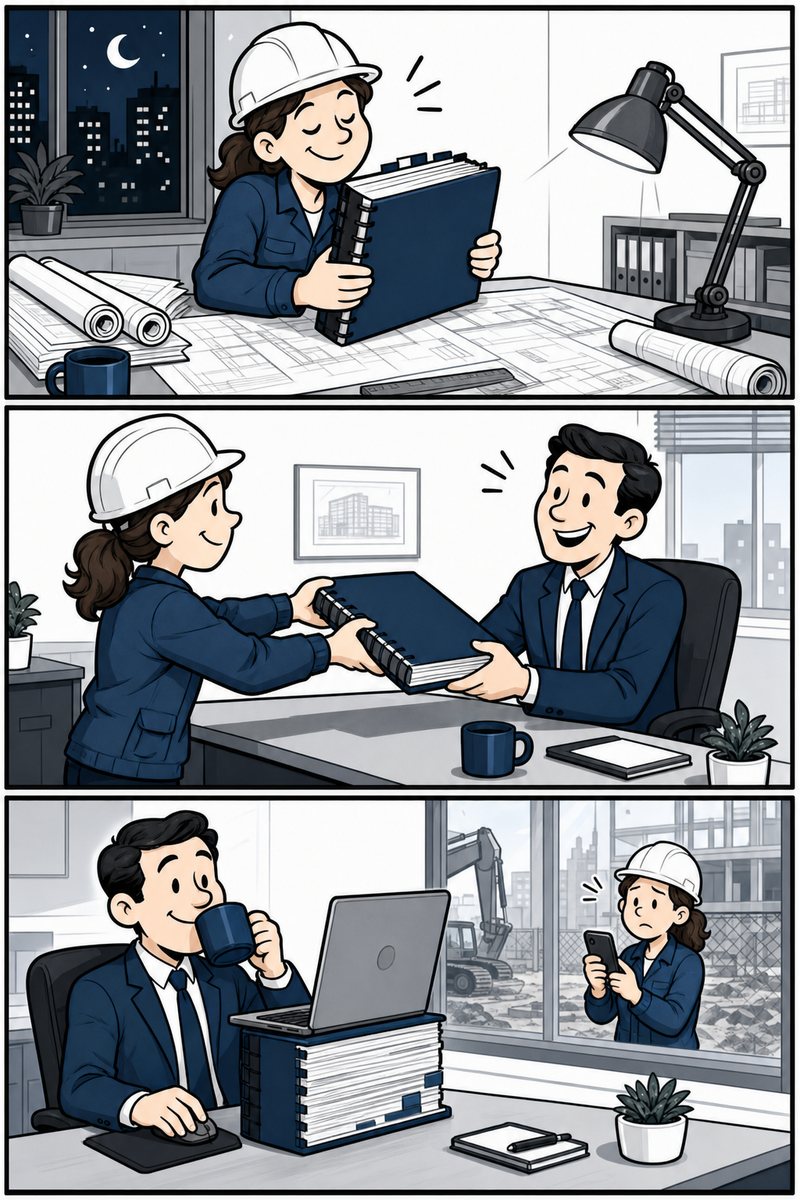
General contractors lose more money to quoted work that goes unanswered than to jobs they never bid. The takeoff and pricing already cost you hours; the follow-up costs minutes and gets skipped because everyone is on a site. We map how a bid moves from walkthrough to signed contract, then build the chasing, the document handoffs and the field-to-office reporting so they stop depending on somebody remembering.
The honest version of our proof here
We do not yet have a published general-contracting case study, and we are not going to dress one up. Here is what the research says about where contractors lose time, and how we would map it in your business.
What the research says
Where contractor time goes, according to the research
PlanGrid with FMI, 2018
PlanGrid with FMI, 2018
PlanGrid with FMI, 2018
Nearly half of rework starts with bad information, so the fix starts with how information moves. That's the part we map first.
We published one build in an adjacent trade with the method shown: read the case study.
- PlanGrid with FMI, Construction Disconnected: The High Cost of Poor Data and Miscommunication (release) (2018).
Run your own numbers on this before you spend another dollar on leads
Three questions, and you can answer all of them from your own records this afternoon.
How many bids did you send last quarter, and how many did you hear back on? Not won: heard back on at all. The gap between those two numbers is quoted work you paid to produce and then never learned the fate of.
What did each of those bids cost you to produce? Site visit, takeoff, pricing, writing the scope. For most contractors it is hours, not minutes, and it is your most expensive people doing it.
What is your average contract value? Multiply that by a deliberately conservative recovery rate on the bids that went quiet: one in ten, not one in three. The number that comes out is usually larger than the entire marketing budget being considered to replace those leads.
That is the argument for fixing the follow-up before buying more enquiries: the bids you already priced are the cheapest opportunities you will ever have.
Think about your last three bids
Three scenes from contracting offices. Not the disasters: the ordinary weeks that quietly cost the most.
You priced a remodel on Thursday, sent it Friday, and it is now three weeks later. Nobody called. The homeowner has either signed with someone else or is still deciding, and you genuinely do not know which, so it stays on the pipeline board forever.
A super texted a question about a detail. It got answered verbally on site. Two weeks on, the architect asks what was decided, and the only record is in somebody's phone.
Before the owner meeting, somebody rings three supers, checks two schedules and opens the accounting file to work out where each job actually stands. That assembly happens every week and produces nothing except a picture that was already true on Friday.
What audited research says about quoted work going quiet
Two figures from the same audited study of 2,241 companies. Both are about what happens after somebody asks you for a price, which is the moment a contractor has already spent the money.
more likely to reach a decision maker, for firms that tried contacting an enquiry within an hour compared with those who tried an hour later. More than sixty times more likely than the ones who waited a day.
was the average first response among firms that replied at all within thirty days, and 23% of the companies audited never responded to the enquiry at any point.
Is your bid-to-contract path 100% working? No contractor's is.
These survive because each one only looks like a few minutes, and because they are invisible on any report you currently receive.
The number exists somewhere across a spreadsheet, an inbox and a project tool. If it takes an afternoon to calculate, it is not a number you can manage by.
When a client goes elsewhere and nobody asks why, you have paid for the takeoff and received no information in return. That is the most expensive kind of loss.
One lives in a project platform, the other lives in a superintendent's head and a whiteboard in a trailer. Both are current. Only one is written down.
Approvals wait behind whoever happens to be driving. It costs a day here and two days there, and it shows up at the end as a schedule everyone blames the weather for.
Three builds that fit how contracting actually works
Built inside Procore, Buildertrend, CoConstruct or whatever your office already runs, because a platform migration during a build season is its own disaster.
Bid follow-up that runs without a person
Every bid sent starts its own sequence, a check-in a few days out, a scope-question touch the following week, a straight decision ask after that. Written in your voice, stopping the moment the client replies. The office stops chasing and starts responding.
One status picture, assembled automatically
Job stage, schedule position and financial position pulled from the platforms that already hold them into a single view before the owner meeting rather than during it. Nobody rings three supers to build a slide.
Field-to-office capture that does not need a laptop
A photo, a voice note or a two-tap form from the site becomes a logged daily report, an RFI or a change-order request attached to the right job, so the decision made in a trailer exists somewhere the architect and the bookkeeper can both find it.
Is this you?
It fits if…
- You are a general contractor, builder or specialty trade doing roughly $1M to $10M.
- You send real bids that cost real hours to produce.
- The office and the field keep two different versions of where a job stands.
- You already run a project platform and an accounting package that do not talk to each other.
It doesn't if…
- You bid a handful of jobs a year. The arithmetic above will not clear the cost of a build.
- You are mid-migration to a new project platform. Come back once it has settled.
- Your problem is that not enough people are calling. That is demand, and it is not what we fix.
What builders ask us on the first call
We already pay for Procore. Why would we need anything else?
You probably do not need another platform. Project software is excellent at holding job information and generally poor at chasing a client who has gone quiet, or at assembling a picture that spans the platform and your accounting file. The work is in those seams.
Procore publishes the seam itself: prime contracts, change orders, budgets, commitments and timecards do not reach QuickBooks Online. We wrote up Procore's own list of what never reaches the books, quoted from its documentation, with the arithmetic to price it against your job log.
Our guys will not use another app.
Correct, and any plan that depends on them doing so has already failed. Capture should happen through what they already use: a text, a photo, a two-tap form. The system does the filing on the other end.
Will automated follow-up make us look impersonal?
Only if it reads like a template. A message that references the specific scope you quoted reads as attentive. The alternative on the table is not a warmer conversation, it is silence for three weeks.
Bidding is judgment. You cannot automate that.
Agreed, and we would not try. Pricing a job is judgment. Sending the follow-up, filing the RFI and assembling the status report are not. Those are the parts currently eating the hours of the person whose judgment you actually need.
How disruptive is this during a build season?
We build one fix at a time, on a roadmap you sign off on, starting with the one that frees the most of your time. If that sits in the office rather than the field, the field is left alone. Nothing goes live in the middle of a critical path if it can go live after it.
What if our real problem is somewhere else?
Then the Assessment says so and you have not spent a build budget finding out. We have told operators to build nothing before, and it is a result we count as a win.
The Sharkitect Standard
No hype. We teach you how it works.
We'll tell you when the answer isn't AI. Our goal: by the end of your first year, you can tell the difference yourself.
Find out what your quiet bids are costing you.
60 to 90 minutes. We map how a bid moves from walkthrough to signed contract, show you where it stalls, and tell you which of those stalls is worth building for, using your bid volume and your contract values.
$250. After the session, we send you a written report: what's slowing you down, what it costs, and what we'd fix first. The $250 credits in full toward the first work you hire us for.