
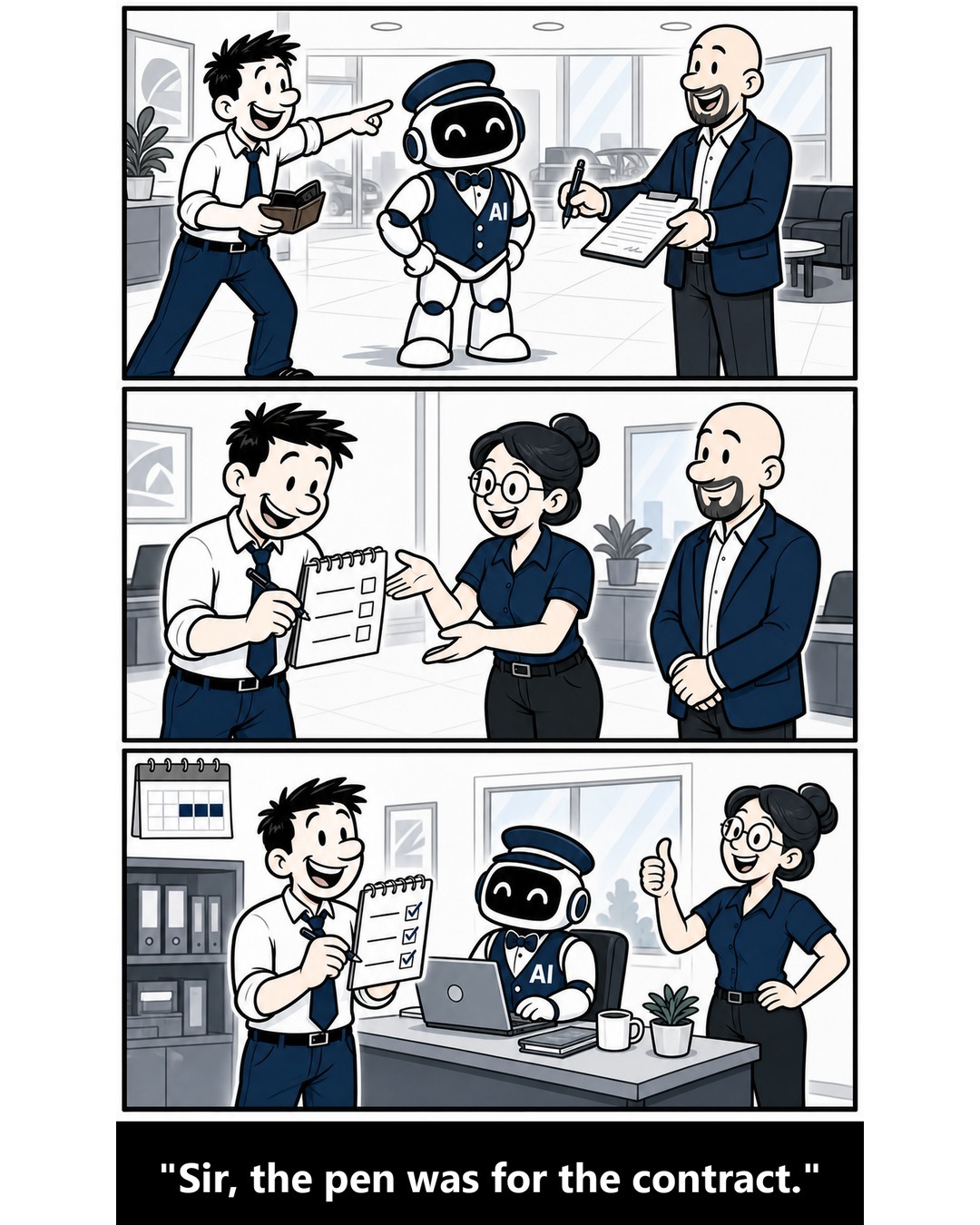
A vendor tells you an AI tool will pay for itself. A headline says most owners who use AI say it helps their bottom line. Six months later, you're still paying the bill and can't say whether it worked. That's the trouble with most talk about AI ROI: nobody decided up front what "worked" would mean.
ROI means return on investment: what you got back compared with what you put in. When an owner tells me AI is helping, my first question isn't "Do you believe it?" It's "How are we measuring that?" Here's how to measure AI ROI in your own business, starting before you buy anything.
What do the AI ROI surveys actually measure?
Three publications from September and October 2026 are easy to read as proof that AI pays off for small businesses. Each one is real, and each measured something narrower than the headline.
- A US small business survey. Echelon Insights surveyed 691 owners for Heartland Forward, a nonprofit, in September 2026. Its release says "43% of small businesses currently use AI" and "70% of those businesses say it has had a net-positive effect on their finances." It ran online with a "non-probability sample" (people weren't picked at random) and covered businesses with 0 to 499 employees. The 70% is AI users rating their own results.
- A survey paid for by Meta. YouGov surveyed 3,983 owners in nine Asia-Pacific markets. Meta's own post reports 84% using AI, with "76% reporting a positive impact on productivity" and "71% reporting a positive impact on revenue or sales over the past 12 months." The post calls the findings a cross-section "rather than being nationally representative of the small business population." Meta commissioned it, and the post promotes Meta's own AI tools for businesses.
- A New York Fed analysis. Two New York Fed researchers looked at a 2025 survey of small employers and found that "firms currently using AI are significantly more likely than non-users to expect increased employment and revenues." Asked about revenue over the next twelve months, AI users who expected a rise outnumbered those who expected a fall by 48 percentage points. Among non-users, the margin was 21. The authors write that whether these firms "actually experience the stronger revenue and employment outcomes they anticipate" is "a subject for future research."
I'm not calling any of these numbers false. But look at what they counted: owners' feelings about their own results, and their forecasts for next year. None of them measured actual results. Feeling more optimistic about AI is not the same as AI growing your business.
"We use AI" and "AI produced results" are two different claims
I'm not skeptical of AI or automation. Both can save real time and money on the right tasks, in the right place in a workflow. What I'm skeptical of is how fast people jump from "we use AI" to "AI produced measurable results."
Revenue can grow for plenty of reasons. You raised prices, hired a salesperson, or had a busy season. AI may have helped, but showing up the same quarter doesn't earn it credit for the whole increase.
Credit gets muddy inside one process too. Say AI drafts a reply to a customer, while plain automation captures the question, routes it and updates your records. If that saves hours, the automation may deserve more of the credit than the AI. The difference between AI and automation matters when you decide what you're paying for.
Why two people can disagree on whether AI worked
The person who built the system says, "We saved your team hours every month." The owner was expecting more revenue, or a smaller payroll, or a department that runs itself. Same result, two verdicts. Both can be right, because nobody agreed up front what the return was supposed to be.
The same trap hides inside a dashboard. Say an AI system reports it handled 1,000 customer questions last month (a made-up number). How many were resolved? How many became customers? How much staff time went to checking and fixing its answers? A number can be accurate by the system's own count and still mislead you.
How to measure AI ROI: write five things down before you buy
Before you buy any AI tool, write down:
- The problem you're solving. One problem, in one sentence.
- Why AI, and not a simple automation or a person. If you can write the rule on an index card, you don't need AI.
- What the work takes today. Hours or dollars, plus how much gets handled and how often it goes wrong. This is your baseline. A simple log of hours per task for two to four weeks is enough.
- The one number that will tell you it worked. Hours per week, errors per month, quotes sent per day. Pick one.
- What a person still checks. Name who reviews the output, and when.
Then, at the end of the quarter, measure the same things the same way.
Count the full cost, too: the subscription, setup, upkeep, the time someone spends reviewing, and the time spent fixing mistakes. A tool that saves five hours a week and needs four hours of checking saved you one.
I learned this in about ten years as a healthcare Performance Improvement Specialist: you don't change a process until you've measured how it runs. Without the "before," the "after" is just a story.
An example: aiming for 20 hours a week, starting from 40
These numbers are an example, not a real client's result.
Take a workflow in your office that runs 40 hours a week across a few people. Start by mapping the process and breaking it into tasks. One piece, copying the same information between two systems, takes 4 hours a week and follows a clear rule. Automation takes that piece. AI then reviews what the automation produced and flags anything that looks off, and a person makes the final call.
Now set the goal: the whole workflow down to 20 hours. Do the arithmetic:
- The automated piece removes 4 hours, so 40 becomes 36.
- The person checking AI's flags spends an hour a week on it, so 36 becomes 37. That hour only pays if the flags catch mistakes that used to slip through, so count errors before and after too.
- That leaves 17 hours between where you'd land and where you want to be.
That gap is the useful part. Either you find 17 more hours in the other tasks, or you agree 20 was the wrong target. Either is workable. Finding the gap after you've paid is not. With the goal written down first, the quarterly check is simple: pull the time log and compare.
Where this approach falls short
Some benefits are hard to count: fewer mistakes, fewer late nights, a calmer office. They're real, even if no single number captures them. Write them down anyway, and check whether they happened.
If you don't know today's numbers, you can't skip ahead. You need a few weeks of tracking first, which delays the purchase. That costs less than a tool you can't judge.
One quarter is too short for some changes. Time saved shows up fast, but more customers can take longer, so set a second check about six months out.
The number you pick can be the wrong number. If you measure questions answered when you needed questions resolved, a tool can hit its target and still not help. Pick the number closest to time or money, not the one that's easiest to pull.
And none of this tells you whether a tool will work before you try it. It tells you, on your own numbers, whether it did.
Questions owners ask
What is AI ROI?
It's what an AI tool gave back compared with what it cost, including the time people spend checking it. "Gave back" can be hours, fewer errors or revenue. Choose which one before you buy.
How long until I can tell whether AI paid off?
Time saved can show within a quarter if you measured the baseline first. Check revenue again around six months.
Can I trust the vendor's dashboard?
Use it, but make sure you can check the important numbers yourself, from your own time logs, your accounting or your customer records. Ask any vendor to help you define success and show you how to verify it yourself. Then verify it.
You might also like what the MIT AI report's 95% number actually measured, which shows how to check an AI statistic before you believe it.